About the Course
Deepen your understanding of Ayn Rand’s Objectivism by seeing how it integrates and contrasts with the ideas of four other titans of philosophy.
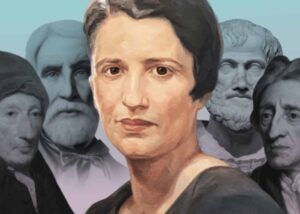
Ayn Rand created an observation-based “philosophy for living on earth,” and the better you understand and apply its principles, the more successful and happy you can be. Toward that end, this course will examine how Rand’s ideas integrate with those of four other important thinkers—Aristotle, John Locke, Thomas Reid, and Auberon Herbert—and how these integrations can help you to think more clearly, live more fully, and advance freedom more effectively.
Aristotle, the father of logic and creator of the ethics of eudaimonia (“good living” or “flourishing”) deeply influenced Rand’s thinking. She regarded his philosophy as “the intellect’s Declaration of Independence” and said, “everything that makes us civilized beings, every rational value that we possess—including the birth of science, the industrial revolution, the creation of the United States, even the structure of our language—is the result of Aristotle’s influence.” Dr. Carrie-Ann Biondi will present key aspects of Aristotle’s philosophy, showing how they form the foundation of Rand’s worldview, integrate with her epistemology and ethics, and can fortify our understanding of principles for flourishing.
John Locke, the father of liberalism, wrote beautifully and powerfully about the nature of knowledge, the importance of independent thinking, and the source and nature of individual rights. Although Locke argued to some extent from a religious perspective, he also made profoundly important secular arguments about the faculty of reason, how it works, and our need for freedom in order to use it. Timothy Sandefur will examine key features of Locke’s philosophy, showing how they integrate with Rand’s ethics and politics, and provide a model for independent thinking.
Thomas Reid, founder of the philosophic school of common-sense realism, substantially refuted the skeptics of his time (e.g., George Berkely and David Hume) by defending the validity of sense perception and the efficacy of man’s mind. Although he too was religious, Reid argued that self-interest plays an important role in ethics, that our fundamental means of achieving our life-serving values is our reasoning mind, and that doing so requires considering the entirety of our lives and the full context of our knowledge. Jon Hersey will compare and contrast various aspects of Reid’s and Rand’s ideas, showing how both thinkers worked toward creating a rational, observation-based philosophy for flourishing.
Auberon Herbert, a 19th-century British political philosopher and member of Parliament, advocated individualism, individual rights, and a social system he called “voluntaryism” (essentially what we now call laissez-faire capitalism). Unlike the vast majority of thinkers who have sought to advocate liberty merely on religious, economic, or historic grounds, Herbert thought and wrote in moral terms—in terms of moral rights, the evil of initiatory force, and the virtue of selfishness, in the rational, rights-respecting sense of the term. Craig Biddle will examine core aspects of Herbert’s philosophy, showing how they integrate with Objectivism and fortify our understanding of the morality of self-interest, the evil of initiatory force, and the necessary good of rights-protecting government.
Meet Your Instructors



How This Course Works
This course is interactive and discussion-driven, so enrollment is limited. Register early to secure your spot.
The course is held live on a video conferencing app called Zoom, which you can download for free here. Sessions are video recorded, so if you miss a session (or want to review), you can watch the recording.
The course is 6 hours long, consisting of 4 sessions of 1.5 hours each. Homework assignments are optional. Doing them may require an additional hour or more per week but will greatly enhance what you learn in this course.
Course handouts and supplementary materials are delivered via email. Course participants are invited to an exclusive OSI Courses group on Facebook, where they can post questions and engage in discussions with the instructor and other participants.
Have a question that wasn’t answered here? Read our FAQ or email us at [email protected].
Frequently Asked Questions
OSI courses are live, interactive, and discussion-driven, so enrollment is limited. Register early to secure your spot.
Courses are held on Zoom, and sessions are recorded, so if you miss a session (or want to review), you can watch the recording. You can download Zoom for free here.
Courses vary in length. And some involve homework. Please see the specific course pages for details.
Course handouts and supplementary materials are delivered via email (please register with an active email address). Participants have access to an exclusive OSI Courses group on Facebook.
Zoom is a free video-conferencing app that we use to conduct our courses. You can download it here.
Sessions are video recorded, so if you miss a session (or want to review), you can watch the recording. That said, we highly recommend attending each live session so that you can ask questions and engage with your instructor(s) and other participants.
If you do miss a session, we recommend that you watch the recording before attending the next session.
Anyone aged 29 or younger may apply for an OSI scholarship to cover the full cost of a course. For information on how the scholarships work, please visit our Scholarships page.
You can see all current and past courses here.
If you have a question that isn’t answered in the FAQ or course description, please email us at [email protected].